Leak Detection and Slab Leak Repair in Walnut Creek
Leak detection in Walnut Creek means finding a hidden water leak, under a slab, inside a wall or out in the yard, without tearing your house apart to look for it. We use electronic leak detection to narrow the spot down, then repair the pipe and can handle the water damage repair and restoration that follows. If your water bill jumped, your meter moves with everything off, or you hear water running when nothing is on, call (925) 887-6347. We are open 24/7, a real person answers, and estimates are free.
- Open 24 hours, including holidays
- Licensed and insured since 1993
- Written price before any work starts
- Senior discount available
Leak detection and repair in Walnut Creek: what we do
We find leaks you cannot see, fix the pipe, and help you put the damaged area back together. That covers slab leaks, leaks inside walls and ceilings, leaks in the buried line between the meter and the house, and leaks in irrigation and outdoor lines.
A hidden leak rarely announces itself. More often it shows up as a bill that does not make sense, a warm spot on the floor, a musty smell in a closet, or a stain that slowly grows on the ceiling below a bathroom. The longer it runs, the more it costs you in water and in damage, so finding it fast matters more than anything else.
Electronic leak detection
Listening and locating equipment that lets us narrow a leak to a small area before we cut anything, so the opening is a patch, not a demolition.
Slab leak repair
Leaks in pipes running under a concrete floor. We locate them, then talk through repairing that spot versus rerouting the line overhead.
Leaks inside walls
Pinhole leaks, failed fittings and drips behind showers and sinks. We open the smallest area we can and fix the source.
Outside and underground leaks
The water main from the meter, irrigation lines and hose bibs. Water leak repair inside and outside is part of the same service.
Water damage repair and restoration
After the pipe is fixed, we offer water damage repair and restoration so the area gets dried out and put right.
Documentation for insurance
We can photograph what we find and what we repair so you have a clear record to share with your insurance carrier.
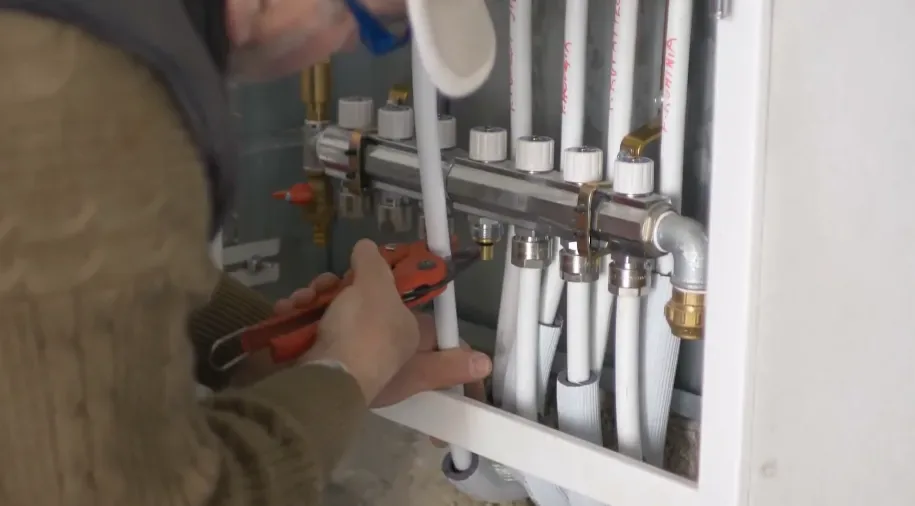
Signs of a hidden water leak
The most reliable sign is a water meter that moves when every tap and appliance is off. Other common signs are a sudden jump in your water bill, the sound of running water, warm spots on a floor, and damp or stained drywall.
| What you notice | What it usually means | How urgent |
|---|---|---|
| Water bill much higher than the same period last year | A running toilet, a dripping irrigation valve, or a hidden supply leak | Check the meter today, call this week |
| Meter leak indicator turning with all water off | A leak somewhere after the meter | Call soon, every hour costs water |
| Warm spot on a tile or wood floor | Hot water line leaking under the slab | Call soon, slab leaks can undermine flooring |
| Sound of running water when nothing is on | Toilet fill valve, or a pressurized leak in a wall or under the floor | Call soon |
| Stain or bubbling paint on a ceiling or wall | Leak from a bathroom, supply line or drain above | Call now if it is growing or soft |
| Musty smell, mildew in a closet or cabinet base | Slow drip that has been going for a while | Call soon |
| Wet strip in the lawn, sinking soil near the front walk | Water main or irrigation line leak | Call now |
| Water in a neighbor's unit or coming through a shared wall | Leak in a supply or drain line serving more than one home | Call now and notify your association |
EBMUD names toilets as the number one cause of high water bills. Before you assume the worst, it is worth checking them, which we explain below.
How to do a meter leak test before you call
Turn off all water inside and outside the house, then look at the small leak indicator on your meter dial. If it is moving, you almost certainly have a leak. This is how EBMUD describes the test, and it takes a few minutes.
- Turn everything offStop all water use in and around the home: faucets, washer, dishwasher, irrigation, ice maker, pool autofill.
- Find the meterEBMUD meters are usually in the ground near the curb under a cement cover. Lift the lid with a tool, then look under the black plastic cover for the dial.
- Watch the leak indicatorEBMUD describes it as often a small triangle or dial that spins when water is flowing. If it moves, you likely have a leak.
- Do a pin test if it is stillLine a pin or toothpick up with the large hand or the triangle's edge, or take a photo. Wait 30 minutes with no water use, then check again.
- Close the house shutoffTurn off the main shutoff at the house and mark the dial again. If it still moves, the leak is likely in the pipe between the meter and the house.
- Call with what you foundIf the dial stops with the house shutoff closed, the leak is likely inside the home. Either way, tell us what you saw and we will start in the right place.
EBMUD meters read in cubic feet. One cubic foot is 7.48 gallons, and one full turn of the large hand is one cubic foot, so even a slow turn adds up over a billing period. EBMUD also reads meters manually about every other month, which is why a leak can run for weeks before the bill shows it.
Two quick toilet checks
EBMUD suggests putting a few drops of food coloring in the toilet tank and waiting 15 to 30 minutes. Color in the bowl means the flapper is leaking. A toilet that hisses or refills on its own is another clue. Those are easy fixes, and our bathroom plumbing team handles them every day.
How electronic and acoustic leak detection works
Pressurized water escaping a pipe makes noise, and that sound travels through soil, concrete and framing. Electronic listening equipment picks it up and lets a plumber move along the pipe route until the sound is strongest, which points to the leak.
Leak detection is a process of elimination more than a single gadget. A typical visit combines several checks:
- Meter test to confirm there is a leak and whether it is before or after the house shutoff
- Isolating hot and cold sides, and individual fixtures where valves allow it
- Pressure testing sections of pipe to see which one loses pressure
- Acoustic listening along the pipe route, through floors, walls and soil
- Looking for warm spots and moisture patterns on floors, walls and ceilings
- Checking toilets, irrigation valves, the water heater and other usual suspects
Where thermal imaging fits
A thermal camera shows temperature differences on a surface. It is most useful for hot water leaks, which warm the floor or wall around them, and for spotting the cool, damp outline of wet drywall. It does not see through walls and it does not replace listening equipment, but it can help confirm what the other tests point to. Ask us when you call which tools fit your situation.
Drain leaks are a different problem because drain lines are not under pressure. For those, a sewer and drain video inspection is usually the better tool, since a camera can show a cracked joint or a separated pipe directly.
Slab leak repair in Walnut Creek
A slab leak is a leak in a water line that runs under a concrete floor. The usual fix is either opening the floor at the leak and repairing that spot, or abandoning the line under the slab and rerouting new pipe through the walls or attic.
| Option | When it makes sense | Trade-offs |
|---|---|---|
| Spot repair through the slab | One leak in otherwise sound pipe, easy-to-reach location | Means cutting concrete and replacing the flooring over it; if the pipe is old, another leak may follow |
| Reroute the line | Older pipe, a second slab leak, or a leak under expensive flooring or cabinets | Leaves the floor alone but needs wall or ceiling openings for the new route |
| Partial or whole-house repipe | Several leaks, corroded pipe throughout, or a mix of old materials | Bigger project, but it ends the cycle of repairs; see repiping |
We will give you a written price for each option that makes sense for your house. The right answer depends on the age of the pipe, how many leaks you have had, and what is sitting on top of the slab.
Why leaks happen in Walnut Creek homes
Most of the leaks we find come from aging pipe, high water pressure, ground movement, or a failed fixture connection. Walnut Creek has plenty of all four.
Much of the city's housing went up in the 1950s and 1960s, when the population went from 9,903 in 1960 to 39,844 in 1970. Homes from that era often have galvanized steel supply pipe, which rusts from the inside and eventually starts to weep at joints and threads. Copper that has been in service for decades can develop pinholes.
Pressure matters too. When a pressure-reducing valve fails, it often lets full street pressure into the house, and that extra force finds every weak fitting and supply hose. Freezing mornings in winter, with a record low of 17F, can crack exposed outdoor pipe and hose bibs. And because this is earthquake country, ground movement over the years can stress buried lines and rigid connections.
Irrigation deserves a special mention. Many yards on the hillsides around Shell Ridge, Lime Ridge and the Tice Valley have long irrigation runs. EBMUD points out that wet or unusually green spots are a clue, and that a dead backup battery in the irrigation controller can keep valves from closing during a power outage.
Leaks in Rossmoor and other attached homes
In attached homes, a leak in one unit can show up in the unit next door or below, so it is important to find the true source before anyone opens a wall. It is also important to find out early who is responsible for which pipe.
Rossmoor is a 55+ community of about 9,800 residents and 6,676 homes, mostly co-ops and condos. About 40% are garden-style duplexes to fourplexes and the rest are mid-rise and high-rise buildings, with some single-family homes. Shared walls and stacked floors mean shared plumbing.
Rossmoor has 23 Mutuals, each with its own board. Rossmoor's insurance information for residents says to consult your Mutual's CC&Rs, bylaws, occupancy agreement and policies to see when the Mutual is responsible, and that owners can be responsible for certain damage caused by appliances, systems or system components they own. It also says every manor owner needs a condominium policy, usually an HO-6 form, because the Mutual's master policy does not cover personal property or personal liability.
- Stop the water if you can, using the fixture shutoff or the unit shutoff
- Let your Mutual or building management know right away, especially if a neighbor is affected
- Take photos of the damage before cleanup starts
- Call us to locate the source, and ask your Mutual about any approval needed before work in shared areas
The same advice applies to condos and townhomes anywhere in town, from Northgate to the complexes near Ygnacio Valley Road. Check your HOA documents, notify the association, and document everything.
Water damage repair, restoration and insurance photos
Once the leak is fixed, wet materials need to be dried or replaced before they grow mold or weaken. We offer water damage repair and restoration, so you do not have to coordinate a separate company just to get the area back in shape.
Insurance coverage for water damage varies a lot from policy to policy, and we cannot tell you what yours covers. What we can do is give you a clear record. When you call, ask us to document the job. We can photograph the leak as we find it, the damaged pipe, the area before and after, and the repair, and give you a written description of what failed and what we did. That is the kind of information an adjuster will ask for.
Leak adjustments on your water bill
Contra Costa Water District says customers who had a leak may qualify for an adjustment to their water bill. CCWD asks for how and when the leak happened, when it was repaired, and proof of repair such as a plumber's bill or parts receipt. CCWD also says no more than one adjustment is made in any 24-month period. Keep our invoice; it is the proof they ask for. EBMUD customers should contact EBMUD about its own policy.
What affects the cost of leak detection and repair
Cost depends mostly on where the leak is and how hard it is to reach. A leak in an open crawlspace is a short job; a slab leak under tile or a leak inside a finished ceiling takes longer to locate and repair.
- Whether the leak is under a slab, in a wall, in a ceiling, or underground in the yard
- How many tests it takes to isolate the line
- Spot repair versus reroute versus repipe
- The amount of drywall, flooring or concrete that has to be opened
- How much water damage repair and restoration is needed afterward
- Shared plumbing in condos and co-ops that needs coordination
Estimates are free, and we give you a written price before repair work starts. We offer a senior discount and accept Mastercard and Visa.
What you can safely check, and when to call
You can safely run the meter test, check toilets with food coloring, look under sinks and behind the washer, and walk the yard for wet spots. Opening walls, cutting into a slab or repairing pressurized pipe is work for a licensed plumber.
- Check supply hoses to the washer, toilets and faucets for bulges or rust at the fittings
- Look at the water heater: EBMUD suggests flushing a few gallons from the drain valve every six months to clear sediment
- Look at the base of the water heater and under the kitchen sink for slow drips
- Walk the irrigation zones while they run and look for geysers or pooled water
- Know where your main shutoff is and make sure it turns
- Cover exposed outdoor pipes and hose bibs on frost nights
Call us right away if water is coming through a ceiling, if the meter is moving and you cannot find why, or if you smell mildew that keeps coming back. For a burst pipe at any hour, use our 24/7 emergency plumber line.
Why Walnut Creek calls us to find leaks
We have been a family plumbing business in Contra Costa and Alameda Counties since 1993, working out of our North Main Street shop in Walnut Creek. Owner Mo Williams grew up in the Bay Area and learned plumbing products and installation at Simon's Hardware in Walnut Creek and Home Depot in Concord.
We hold a 4.7 Google rating from 251 reviews as of October 2026. One customer wrote that Kevin solved their problem and fixed their water leak in a timely manner. We are a California licensed C-36 plumbing contractor, licensed and insured, BBB Accredited A+, and members of PHCC and the Walnut Creek Chamber of Commerce and Visitors Bureau.
Related services
If leaks keep coming back, a repipe may be the long-term fix. A whole-house plumbing inspection can catch small leaks before they become damage, and our water heater service covers leaking tanks and fittings.

A family business led by Mo Williams since 1993
We are a Walnut Creek family business run from our North Main Street shop. Owner Mo Williams grew up in the Bay Area and learned plumbing products and installation from the inside out at Simon's Hardware in Walnut Creek and Home Depot in Concord. His wife Ann runs the books as CFO. We're rated 4.7 on Google from 251 reviews (October 2026). Meet Mo


Frequently asked questions
How do I know if I have a hidden water leak?
The surest sign is a water meter that moves when every tap, appliance and irrigation zone is off. Other common signs are a water bill much higher than usual, the sound of running water when nothing is on, warm spots on a floor, musty smells, and stains on walls or ceilings. If the meter test shows movement, call a plumber to locate the source.
How does electronic leak detection work?
Water escaping a pressurized pipe makes sound that travels through concrete, soil and framing. Electronic listening equipment picks up that sound so a plumber can follow the pipe route to the spot where it is loudest. Combined with meter tests, pressure tests and isolating hot and cold lines, it narrows a leak to a small area before any wall or floor is opened.
What is a slab leak and how is it repaired?
A slab leak is a leak in a water line that runs under a concrete floor. Warm spots on the floor, running water sounds and a moving meter are common signs. Repair options are opening the slab and fixing that spot, rerouting the line through walls or the attic, or repiping if the pipe is failing throughout. We price each option that fits your home.
How do I check my EBMUD meter for a leak?
Turn off all water in and around the home, then look at the leak indicator on the meter dial, which EBMUD describes as often a small triangle or dial that spins when water flows. If it moves, you likely have a leak. If not, mark the large hand, wait 30 minutes with no water use, and check again. Movement means a leak.
Why is my water bill suddenly so high?
A sudden jump usually means water is running somewhere you cannot see. EBMUD says toilets are the number one cause of high bills, so start with a food coloring test in each tank. Irrigation leaks and hidden supply line leaks are next. Run a meter test with everything off; if the leak indicator moves, call us and we will locate it.
Who pays to fix a leak between the meter and my house?
In EBMUD territory, the homeowner does. EBMUD repairs leaks on the street side of the meter and the meter itself, while pipe on the customer side, including the service line to the house and irrigation, is the owner's responsibility. If your home is served by CCWD, contact the district to confirm where its responsibility ends at your address.
Can you help with water damage after a leak?
Yes. LeapFrog offers water damage repair and restoration, so once the leak is located and the pipe is repaired, we can handle putting the damaged area back in order. We can also photograph what we find and what we fix and give you a written description of the failure and repair, which is useful information to share with your insurance carrier.
What should I do about a leak in my Rossmoor home?
Stop the water at the fixture or unit shutoff if you can, notify your Mutual or building management, and take photos before cleanup. Rossmoor advises residents to check their Mutual's CC&Rs, bylaws, occupancy agreement and policies to see when the Mutual is responsible. Then call us to find the source, since in attached homes the leak may start in a different unit.
Can I get a water bill adjustment after fixing a leak?
Possibly. Contra Costa Water District says customers who had a leak may qualify for a bill adjustment, and asks for when and how the leak happened, when it was fixed, and proof of repair such as a plumber's bill. CCWD allows no more than one adjustment in any 24-month period. EBMUD customers should ask EBMUD about its own policy.
Is leak detection worth it, or should I just open the wall?
Finding the leak first is almost always worth it. Opening walls or concrete on a guess can mean several holes, more patching, and more cost, and you may still miss the source. Leak detection narrows the spot down so the opening is small and in the right place. Estimates are free, so calling costs you nothing but a few minutes.
Other ways we help Walnut Creek homes
Call a Walnut Creek plumber for leak detection
A real person answers 24 hours a day, 7 days a week. Tell us what's happening and we'll give you an honest arrival window and a free written estimate before any work starts.
Call now, day or night
(925) 887-6347- Licensed plumber, not a salesperson
- Free written estimate before work begins
- Senior discount, ask when you call
- Mastercard and Visa accepted
- Non-urgent questions: balzaparis@gmail.com
Water or sewage spreading? Shut off the fixture or main valve, then call. Smell gas? Leave first and call PG&E at 1-800-743-5000 or 911 from outside.
2108 N. Main Street, Suite F
Walnut Creek, CA 94596
Phone: (925) 887-6347
Email: balzaparis@gmail.com
Open 24 hours, 7 days a week